Inventory and accounting
Know what each portion really costs you
Moment of the day: Opening
The Digigarson inventory and accounting module follows ingredients from purchase to recipe and from sale to stock count, and records where the money goes with double-entry bookkeeping. Cost is calculated per ingredient card with the weighted average method.
Stock items and purchasing
Bulk-load ingredient cards from Excel and search them easily. Enter purchase invoices; returns, price differences and extra costs such as freight are recorded too. Foreign-currency purchases can use the Turkish central bank (TCMB) rate.
- Bulk import with Excel
- Purchase invoices, returns and price differences
- Purchase orders and order suggestions
- Supplier statements and supplier rating
Recipes and food cost
Enter a recipe for each product; separate recipes can be defined per price option, such as portion or size, and per product option. Semi-finished items such as sauces, doughs and syrups are defined with their own recipes. Recipes are versioned: a change is saved as a new version. Each product's cost and its ratio to the selling price (food cost) are shown.
Automatic stock deduction on sale
Once enabled for the branch, the recipe's ingredients are deducted from stock as checks are closed. When a check is voided or reopened, the deduction is reversed.
Production, waste and stock counts
Semi-finished items enter stock through production orders. Waste entries need approval, and unusual waste and losses trigger a warning. Stock counts are carried out and count differences are reported.
Cash, bank and supplier payments
Cash and bank accounts, supplier payments, expenses, cheques and promissory notes are kept with double-entry bookkeeping; a trial balance is available at any time. The day's Z report and house-account movements are posted to the books automatically. Card and meal-card collections are matched with bank statements; settlements and commissions are tracked.
P&L and menu engineering
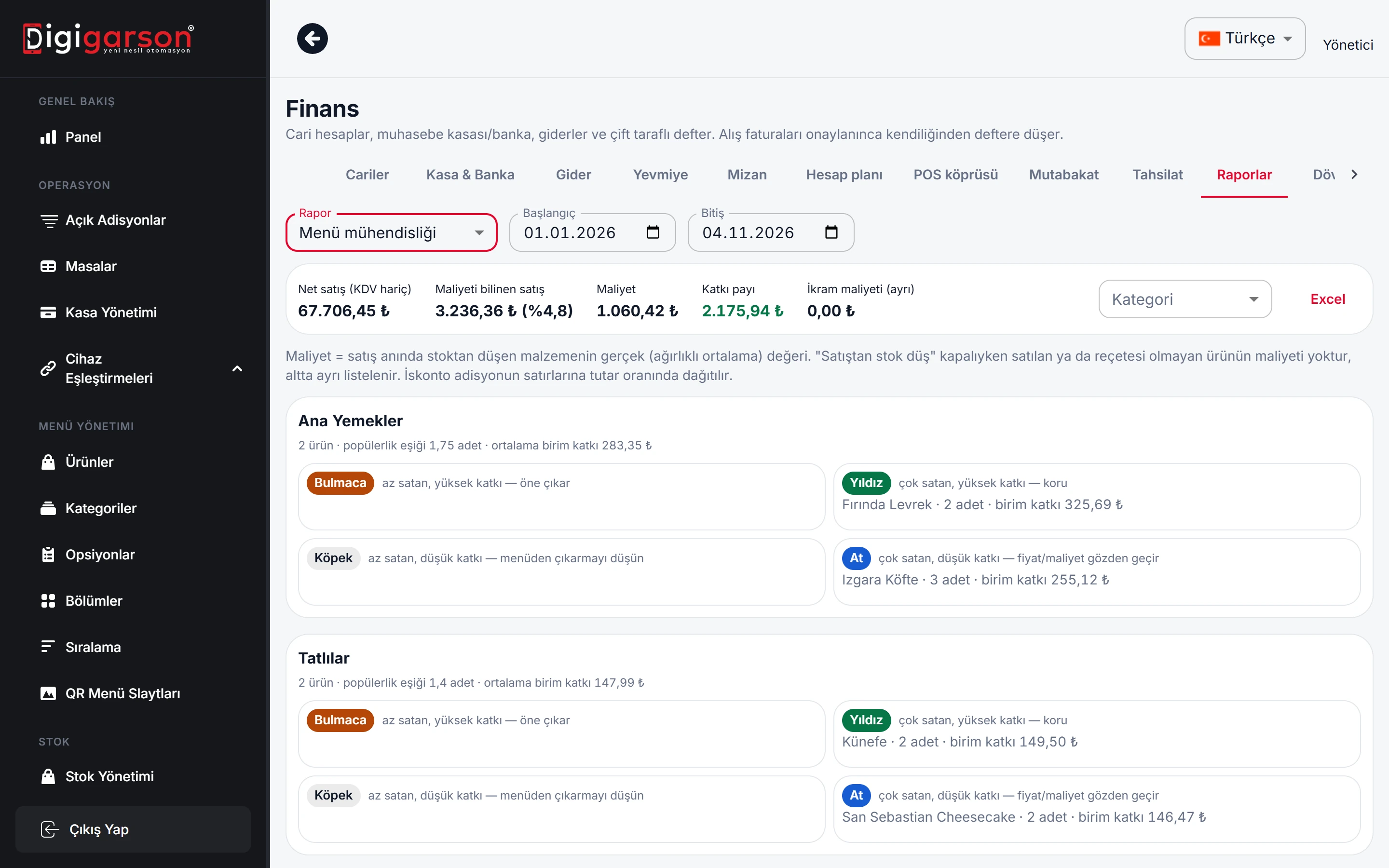
Profit and loss, cash flow and receivables ageing; product profitability and menu engineering (which item sells a lot, which earns a lot); theoretical versus actual usage, waste, count differences and supplier price changes. Reports export to Excel.
- VAT breakdown by rate
- Budget tracking
- CSV export for your accountant
Several branches
Businesses with a branch group can transfer ingredients between branches; sent goods show as in transit until the receiving branch accepts them.
Frequently asked questions
Which method is used to calculate cost?
Weighted average cost per ingredient card.
Does stock go down automatically when I sell?
Yes, once stock deduction on sale is enabled for the branch: as checks are closed, the recipe's ingredients are deducted from stock.
What is menu engineering?
A report that groups products by sales volume and profitability, helping you decide which item to promote and which one's price or recipe to review.
See how it works in your own venue
Let's talk about your tables, menu and printer layout and work out the right setup together. Our WhatsApp line is open 24/7.